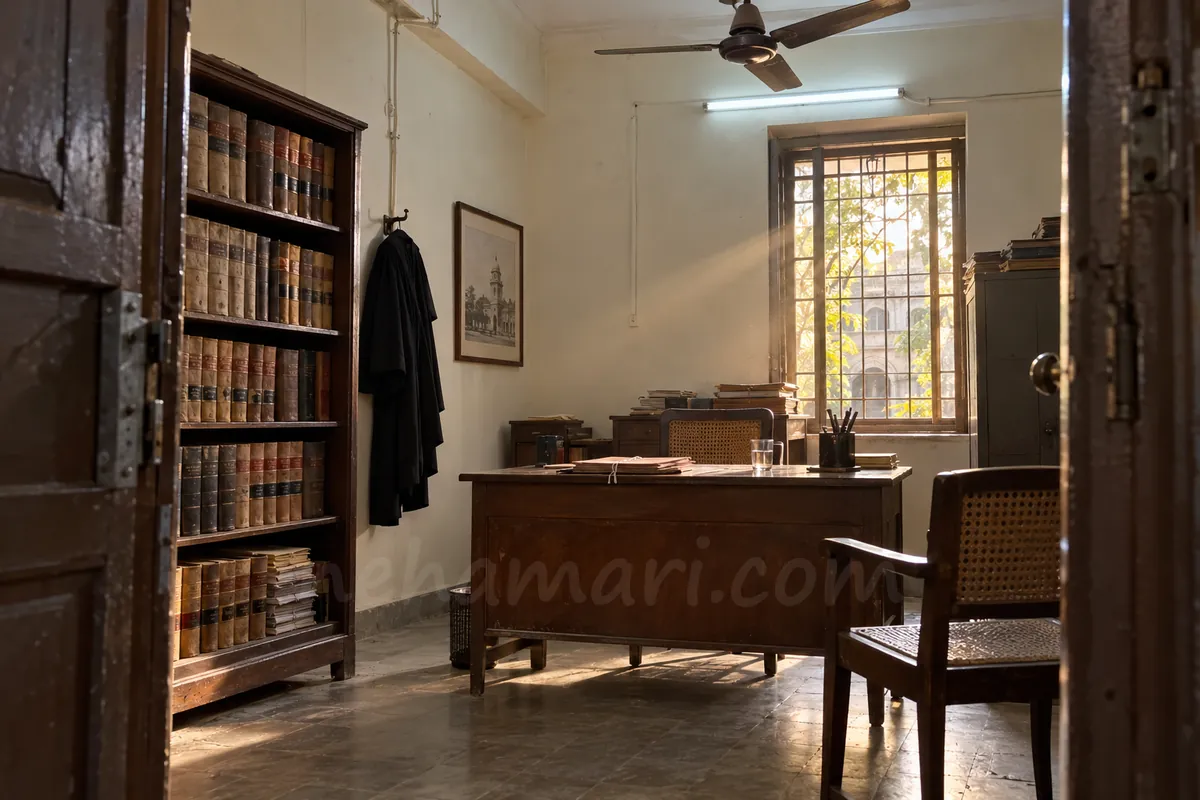
What the 1956 law punishes, and what it leaves alone
Ask 'is prostitution legal in India?' and you will hear both answers, yes and no. Both are half true, and the main law shows why. That law is the Immoral Traffic (Prevention) Act, 1956, often called ITPA. It was passed in 1956 as the Suppression of Immoral Traffic in Women and Girls Act and got its present name in 1986. It does not make prostitution by one adult, on its own, a crime. What it goes after is the business around it: the brothel, the pimp, and the person who brings someone into the trade.
The law's meaning of a brothel is wide: any house, room, vehicle or place used for sex work for someone else's gain, or for the shared gain of two or more sex workers. In its 2026 judgment the Supreme Court noted that a woman who works alone from her own home, with nobody else involved in running the place, is not running a brothel.
The offences, section by section
These are the parts of the 1956 Act that make something an offence, in plain words:
- Section 3: keeping or managing a brothel, or helping to run one. A tenant who lets a room be used as a brothel, and a landlord who rents out a place knowing it will be one, are caught too.
- Section 4: living on the earnings of prostitution, meaning another person's sex work, by anyone over 18. A man who lives with a sex worker, controls where she goes, or acts as her tout or pimp is presumed to be doing this unless he proves otherwise.
- Section 5: procuring, persuading or taking a person for sex work, even with her consent.
- Section 6: holding a person in a brothel, or anywhere else for sex, with or without her consent.
- Section 7: sex work in an area the state has notified, or within 200 metres of a place of worship and certain other public places. It names both people, the sex worker and the person with her, and the jail term is up to three months.
- Section 8: soliciting, which means trying to draw someone into sex work in a public place, or where people in a public place can see or hear it.
general information only
| What happens | The law says | Where |
|---|---|---|
| An adult sells sex by choice, in private | Not an offence by itself | Supreme Court, 2022 and 2026 |
| Keeping or running a brothel | Offence | ITPA Section 3 |
| Living off someone's sex work, as pimp or tout | Offence | ITPA Section 4 |
| Procuring or taking a person for sex work | Offence, even with consent | ITPA Section 5 |
| Sex work near listed public places, or soliciting | Offence | ITPA Sections 7 and 8 |
| Trafficking, or using a trafficked person | Offence, 3 years or more in jail | BNS Sections 143 and 144 |
What the Supreme Court said in May 2022
In Budhadev Karmaskar v. State of West Bengal, the Supreme Court passed an order on 19 May 2022. The judges said that every person in India, whatever their work, has a right to live with dignity under Article 21 of the Constitution.
The order quoted a panel's advice in plain terms: when it is clear that a sex worker is an adult and is taking part with consent, the police must not interfere, and in a raid on a brothel the sex workers should not be arrested or harassed, 'since voluntary sex work is not illegal and only running the brothel is unlawful'.
The central government did not agree with every point, so the court told the states to follow six of the panel's points straight away and kept the rest for later. Among the six: police must treat sex workers with dignity and must not abuse them, the media must not show their faces or names during raids and rescues, and a condom must not be treated as proof of a crime. You can read the Supreme Court order of 19 May 2022 itself.
The 2026 judgment: an adult's own choice comes first
On 29 May 2026, in Prajwala v. Union of India, two judges of the Supreme Court went a step further. When an adult is brought before a magistrate after a raid, the magistrate must first find out whether she is a voluntary adult sex worker, and whether she wants to be kept in a protective home at all. Her own wishes come first. They can be set aside only in rare cases, such as a real risk to her safety or signs that she was forced, threatened or tutored.
The judges repeated that voluntary sex work is not illegal and only running a brothel is. They also noted that the government had promised a full new anti-trafficking law back in 2015 and that, as of that judgment, none had been passed. So in 2026 the 1956 Act is still the law.
Trafficking under the BNS: the part that can reach the customer
The Bharatiya Nyaya Sanhita, 2023 (BNS) replaced the old Indian Penal Code on 1 July 2024. Its Section 143 makes trafficking a crime: recruiting, moving, hiding or receiving a person through threats, force, fraud, abuse of power or payments, in order to exploit her, sexually or in any other way. Once those means are used, her consent does not matter. The basic punishment is seven to ten years in jail.
Section 144(2) is the one a customer should know. Anyone who, knowing or having reason to believe that a person has been trafficked, engages that person for sexual exploitation faces three to seven years in jail and a fine.
What this means for a man in Bangalore
The same central laws apply in Bangalore as in the rest of India. In plain words, this is where a man's own risk lies:
- Near a place of worship or another listed public place, or in an area the state has notified, Section 7 names the man too. Some High Courts, including Karnataka's in 1965, when it was still the Mysore High Court, have read it to cover the customer; others, such as the Allahabad High Court in 2024, have not.
- A street pickup starts with soliciting, an offence under Section 8. Our red light area post explains why those spots are risky in other ways too.
- If the woman was trafficked and you knew, or had reason to believe it, BNS Section 144 can apply to you, with a minimum of three years in jail.
- Running a brothel, taking a cut of a woman's earnings or bringing someone into sex work are offences under Sections 3, 4 and 5, whatever name the business uses.

This is general information, not legal advice
This page does not say that any booking, with us or with anyone else, is safe from the law. Courts read these sections case by case, and laws and court orders change. Neha Mari is a booking desk, not a law firm. If you have a real legal question about your own situation, ask a lawyer.
Last updated · Neha Mari